

Should voice search be a consideration in your SEO strategy?
Voice recognition technology is developing at a significant pace, and voice search usage is increasing too.
To help you to learn how to adapt your SEO strategy accordingly and keep pace with these changes, we’ve compiled a list of the latest voice search statistics, facts, and trends.
To help you to learn how to adapt your SEO strategy accordingly and keep pace with these changes, we’ve compiled a list of the latest voice search statistics, facts, and trends.
These stats will reveal the state of the voice search industry this year, highlight the ways people interact with voice assistants and smart speakers, and shed light on some important SEO ranking factors for voice search.
Editor’s top picks – voice search statistics
These are our most interesting statistics about voice search:
- 41% of US adults use voice search daily, higher in comparison to countries globally. (Source: Google Mobile Voice Survey)
- Voice search is the second most popular channel for mobile searches. (Source: Search Engine Land)
- On average voice assistants can answer 93.7% of all search queries. (Source: Semrush)
Voice search usage statistics
Let’s start by taking a look at some general voice search statistics that show us how popular voice search is and the ways people use it.
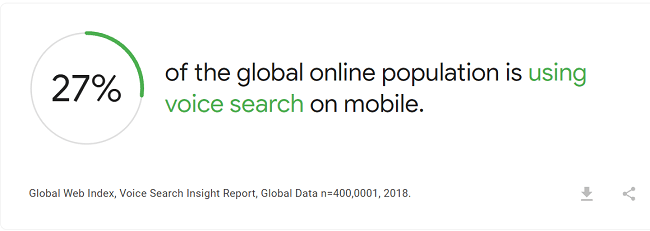
1. 27% of the global online population uses voice search on their mobile devices
According to data from Think with Google, more than a quarter of the online population of the world is now using voice search on mobile.
That’s not quite the ‘complete voice search takeover’ many analytics predicted when the technology was still in its infancy a few years back – on the contrary, most users still seem to prefer to search the old-fashioned way – but it’s impressive nonetheless.
Source: Think with Google2
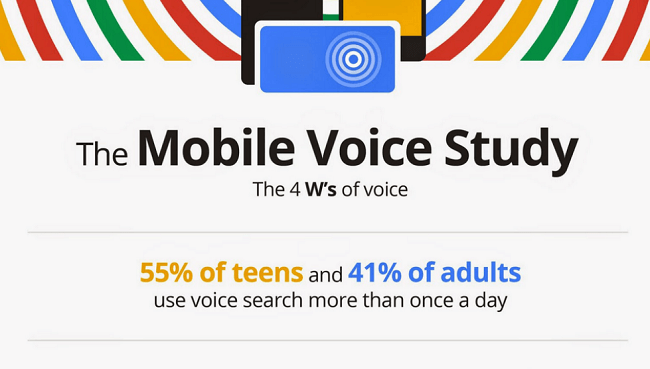
2. 41% of US adults and 55% of US teens use voice search daily
In the US, voice search seems to be a little more popular than it is globally. 41% of American adults and over half of teens in the country use voice search every day, according to a Google Mobile Voice survey. However, it’s worth noting that this study is from 2014 so it might not be as accurate now as it was a few years back.
Source: Google Mobile Voice Survey
3. 58.6% of US consumers have used voice search
This more up-to-date statistic from Voicebot confirms that voice search has definitely taken off in the US. According to the study, over half of all US citizens have used voice search at least once in their lives, even if they don’t do so regularly.
Source: Voicebot
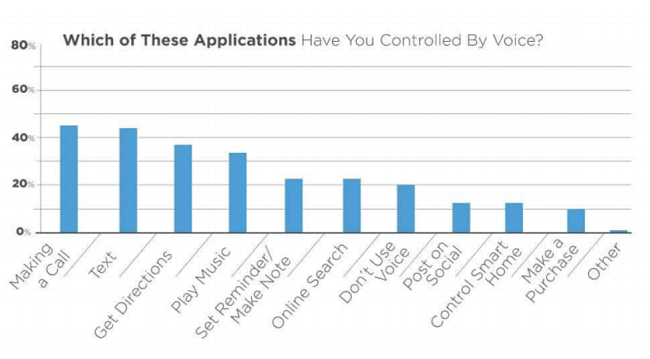
4. Voice search is only the sixth most popular voice activity
According to one survey, only 23% of respondents reported searching via voice. This makes voice search only the sixth most popular voice-related activity. It ranked behind making a call, texting, getting directions, playing music, and setting reminders.
Source: Search Engine Land
5. Voice search is the second most popular channel for mobile searches
Voice search might only be the sixth most popular voice activity, but it’s the second most popular search method for mobile users.
Only browser search is more popular than voice search. People seem to prefer searching through voice than through other search entry points like the phone’s search box, search app, etc.
Source: Search Engine Land
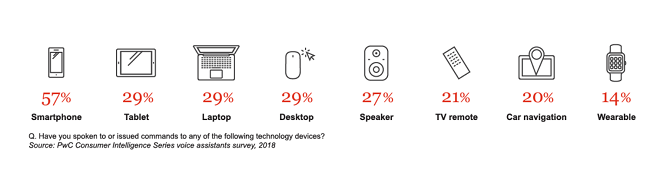
6. Smartphones are the most popular devices for voice search
No surprises there, then. According to a survey by PWC, 57% of respondents claimed to have spoken to their smartphones, compared to just 29% on tablets, laptops, and desktops.
Why is voice search more popular on mobile than on other devices? Well, it probably has something to do with the fact that we’re more used to talking on our mobiles than other devices, given that we use them for calls all the time.
Plus, voice search requires an audio input and not all desktops and laptops have in-built microphones.
Source: PWC
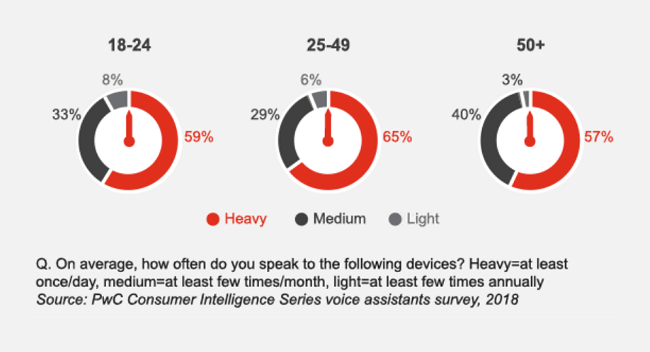
7. 25 to 49-year-olds use voice search more often than any other age group
65% of people in this age range use it at least once a day, compared to 59% of 18 to 24-year-olds and 57% of 50+. Younger consumers may be driving the adoption of voice search but as this statistic shows, it’s actually slightly older people that are the most prolific users.
Source: PWC
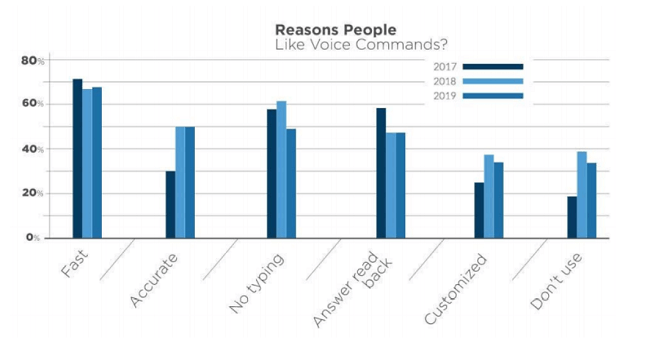
8. Around 70% of people like voice search because it’s fast
A recent survey from 2019 asked people why they like voice commands. The most common reason people cited was that it’s fast – after all, speaking into your phone is usually a lot quicker than opening up your browser and typing a query in. ‘Accuracy’ and ‘no typing requirement’ were other popular reasons people gave for liking voice search.
Source: Search Engine Land
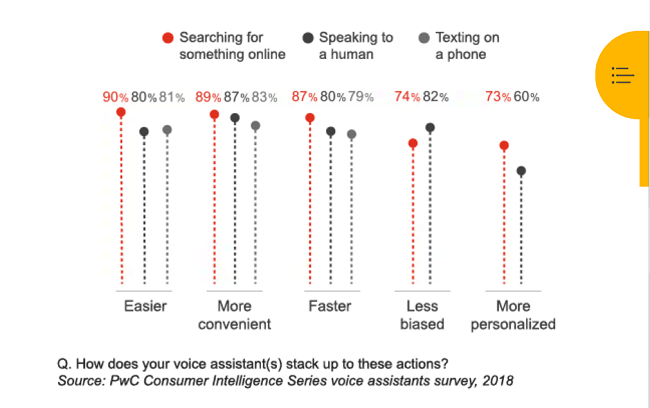
9. 90% of people think voice search is easier than searching online
The vast majority of people think searching via voice is easier than searching for something online. Not only that, but 89% also think it’s more convenient, and 87% think it’s faster.
Source: PWC
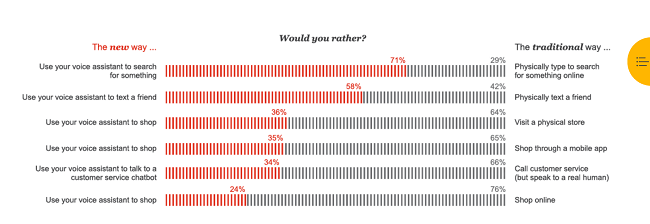
10. 71% of people would rather use voice search than physically type a search query
Following on from the above, consumers show a clear preference for voice assistants when it comes to search. 71% of consumers also said they’d rather use voice search than physically type a search query. Given that people seem to overwhelmingly feel that voice search is better, it’s surprising that it isn’t more commonly used.
Source: PWC
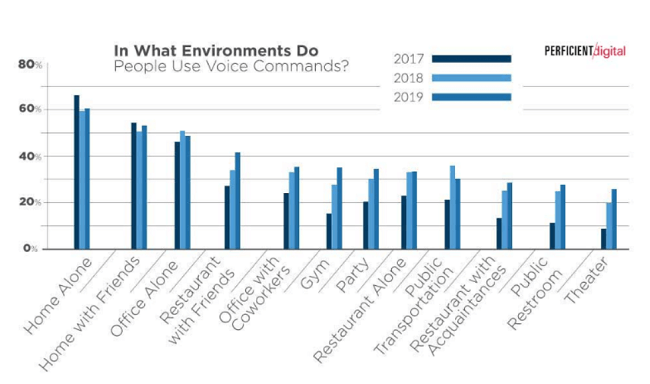
11. Most people use voice search when they’re home alone
Over 60% use voice search when they’re home alone, making this the most popular environment for voice search. Other popular environments for voice search included ‘at home with friends’ (over 50%), ‘alone at the office’ (around 49%), and ‘at the restaurant with friends’ (over 40%).
Source: Search Engine Land
Voice assistant statistics
Voice assistants are digital assistants that use voice recognition and language processing technology. This enables them to ‘hear’ voice commands and perform functions accordingly.
Many people who conduct voice searches do so through voice assistants, so let’s take a look at some stats that tell us more about this technology.
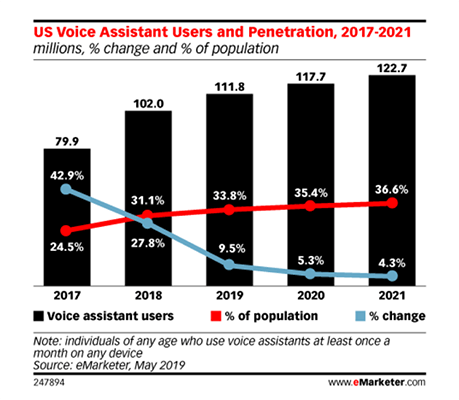
12. 36.6% of the US population use voice assistants
That’s over 120 million people. Most modern smartphones come with voice assistants (think Siri, Cortana, etc.) so they’re fairly ubiquitous.
Source: eMarketer
13. 66% of people who use digital assistants use them weekly
Most people who use voice assistants do so on a regular basis. 66% interact with their digital assistants at least once a week, and 19% do so daily.
Source: Microsoft & Bing
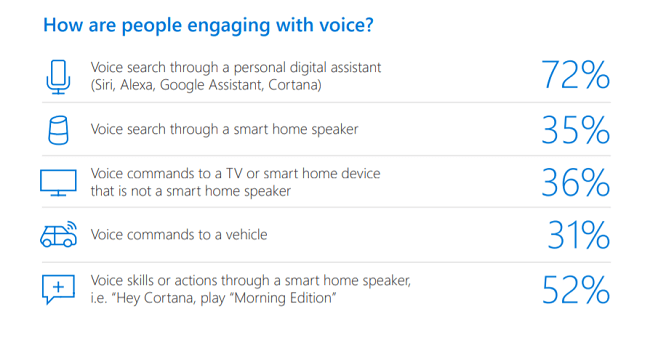
14. 72% of people report using voice search through their personal digital assistant
Nearly three-quarters of those who use voice search do so via their personal digital assistant. That includes Siri, Alexa, Cortana, and Google Assistant.
Source: Microsoft & Bing
15. 93% of people are satisfied with their voice assistants
According to a recent survey, 50% of people are ‘very satisfied’ and 43% are ‘somewhat satisfied’ with their digital assistants. This shows how far voice recognition technology has come since the early days when trying to use it was often frustrating and ineffective.
Source: PWC
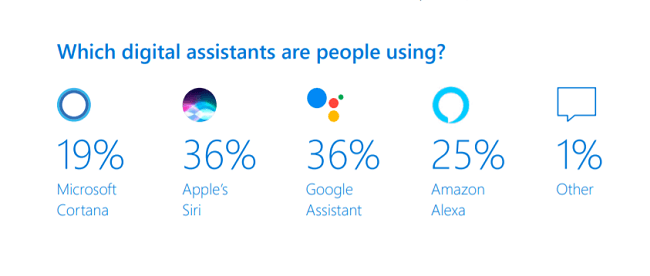
16. Apple’s Siri and Google Assistant are the most popular digital assistants
Siri and Google Assistant are the clear market leaders in the voice assistant technology industry. Each holds around 36% of the market share.
Alexa trails behind at 25%, and Cortana comes in at a distant third place at 19%. Together, these four voice assistants almost completely control the market. Other assistants are only used by 1% of users.
Source: Microsoft & Bing
17. 68% of people use digital assistants to search for quick facts
This is the #1 most popular use case for digital assistants, according to respondents in a recent survey.
Asking for directions was the second most popular response, with 65% of respondents saying they used digital assistants for this purpose.
Other popular uses included searching for products/services (52%), searching for a business (47%), and researching products/services (44%)
Source: Microsoft & Bing
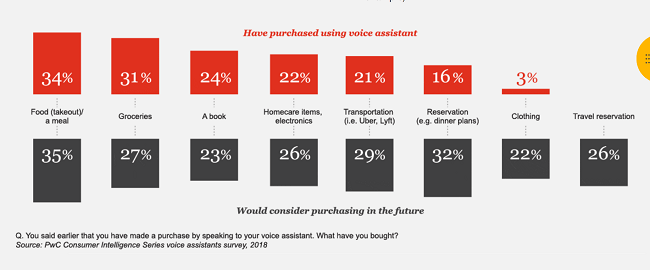
18. 34% of people have purchased takeout food using their voice assistant
This is the most common voice-assistant-driven purchase. Comparatively, only 3% have ordered clothing using their voice assistant. This makes a lot of sense – ordering takeout food is a very simple and low-risk purchase compared to ordering clothing.
With the former, many customers already know what they want to order, whereas, with the latter, most buyers would want to compare their options and at least see a photo of the item of clothing before they’re ready to buy.
Source: PWC
19. The average answer match across Google Assistants is 22%
There are many different Google-run devices capable of running voice searches, such as Google Home Hub, Google Home Mini, and Android devices.
A study by SEMrush found that despite all using similar technology, users will usually get different answers to their queries depending on which Google-run smart device they use to conduct their voice search. In only 22% of cases will different devices give exactly the same answer to the same query.
Source: SEMrush
20. Over 50% of consumers expect to be able to make purchases through digital assistants in the next 5 years
Consumers seem to be optimistic about the future of voice assistant technology. Over the next 5 years, over half of users expect to be able to make purchases through their digital assistants. And considering how far digital assistants have come in the last 5 years, I’d wager they won’t be disappointed.
Source: Microsoft & Bing
21. Voice assistants can answer 93.7% of all search queries on average…
SEMrush looked at how often different voice assistants failed to answer search queries and found that they were only unable to answer 6.3% of questions, on average, across devices. This shows how far voice search technology has come in recent years as a little over a year ago, that figure would have been as high as 35%.
Source: SEMrush
22. …but Alexa struggles to answer almost a quarter of all queries
Alexa seems to be trailing behind other voice assistants when it comes to voice search. In the SEMrush study, Alexa failed to answer 23% of queries compared to just 2% on Siri, and 6.3% across devices.
This is probably because, unlike other assistants, Alexa wasn’t designed to be a voice search assistant. It was intended to primarily be a smart home speaker.
Source: SEMrush
23. Google Assistant returns the longest voice search answers of all voice assistants
The average answer to a voice search query on Google Assistant was 41 words. This is significantly higher than other assistants. For comparison, Alexa returned an average answer length of just 11 words, and the average answer length across all assistants was 23 words.
Source: SEMrush
Smart speaker statistics
Voice searches don’t just happen on mobile – many people use their smart devices to search online too. With that in mind, let’s take a look at some smart speaker statistics.
24. 35% report using voice search through a smart home speaker
Over a third of consumers say they’ve used their smart home speaker to search for something, and a further 36% of people report using voice commands through other IoT devices like TVs.
Source: Microsoft & Bing
25. 45% of people owned a smart speaker in 2019.
That figure is up from 23% the year before, according to a report by Microsoft and Bing. The report also predicted that 75% of people would own a smart speaker by 2020, but this estimation might have since proved to be overly optimistic.
Source: Microsoft & Bing
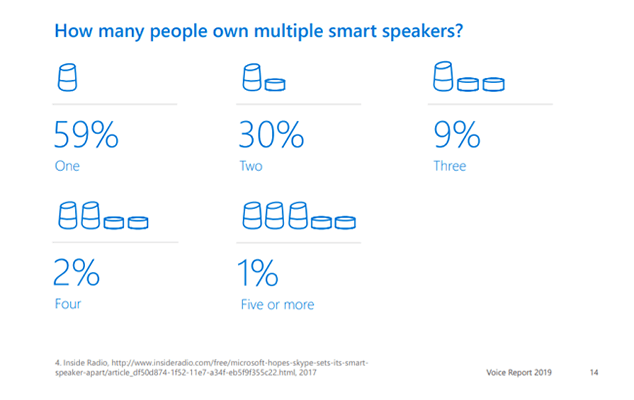
26. Of those that own smart speakers, 41% own two or more
Nearly half of all people who use smart speakers own multiple devices. 59% own just one, but 30% own two, 9% own three, 2% own four, and 1% own 5+. Owning multiple smart speakers allows you to conduct voice commands in different rooms across your home. They can often also sync up together and with other devices in your home for a more connected experience.
Source: Microsoft & Bing
27. Playing music is the most common voice activity on smart speakers
70% of smart speaker users use their voice to ask their device to play music. Asking for the weather was the second most common voice request (64%) and asking fun questions was third
(53%). Interestingly, voice search was only the fourth most popular smart speaker activity according to the study, with only 47% of respondents saying they used their devices for this purpose.
Source: Adobe
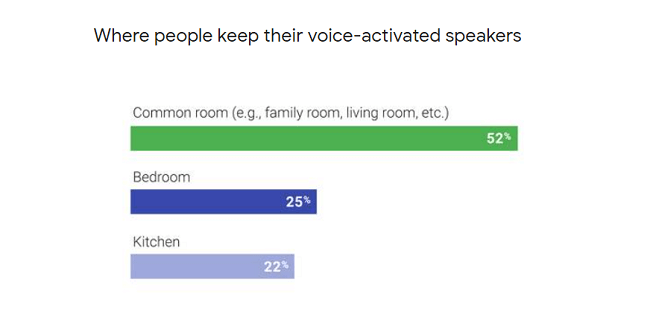
28. 52% of people keep their smart speakers in a common room
By common room, we’re talking about any common/shared living areas, like living rooms, lounges, etc. Around 25% of homeowners keep their smart speakers in their bedroom, and 22% keep them in the kitchen. Very few people use them in the bathroom or other rooms in their homes.
Source: Think with Google1
29. The global voice recognition technology market size reached over $10.7 billion in 2020
It’s also expected to grow at a CAGR of 16.8% over the next 5 years, reaching a whopping 27.16 billion by 2026
Source: Statista1
SEO and voice search statistics
If you want to stand the best chance of ranking organically for voice search queries, check out the voice search statistics below. These SEO stats tell us more about how voice search relates to SEO and reveals important ranking factors.
30. 22.8% of SEO professionals think voice search is the most important emerging SEO factor to watch
A survey by Search Engine Journal asked SEOs what they think the most important emergent factors were in SEO, and nearly a quarter of respondents said voice search.
Voice search was the fifth most popular response to that particular question. Core Web Vitals was the top response with 36.6% of survey respondents rating it the most important emergent SEO factor.
Source: Search Engine Journal
31. 80% of voice search answers on Google Assistant come from the top 3 results
Data from SEMrush found that the vast majority of answers to voice search queries were pulled from the top 3 organic results. The upshot: If you want to get featured in voice search answers on Google Assistant, you’ll need to rank at the very top of the SERPs first.
Source: SEMrush
32. 70% of voice search answers come from SERP features
SERP features like Featured Snippets (the answer boxes at the top of the results pages) and People Also Ask sections have become more and more important to SEO over the last few years – and they’re especially important to voice search.
A study by SEMrush found that more than two-thirds of all voice search answers on Google Assistant came from these kinds of SERP features.
Source: SEMrush
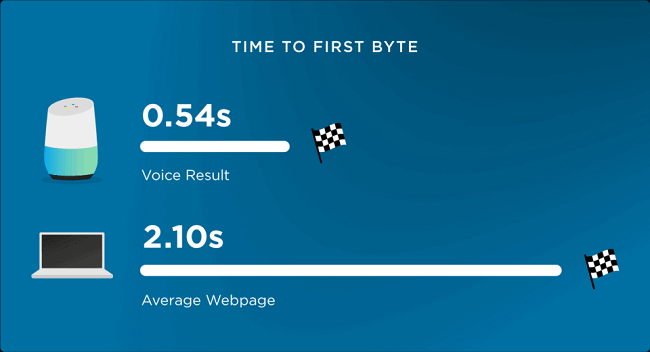
33. Pages that rank for voice searches load 52% faster
The average voice search result page loads in approximately 4.6 seconds. This is 52% faster than regular search results pages and suggests that PageSpeed may be a particularly important ranking factor for voice search SEO.
It makes sense that Google would prioritize PageSpeed when it comes to voice search. When you speak into your smart device, you expect an almost instantaneous response – you don’t have time to wait around for the results to load.
Source: Backlinko
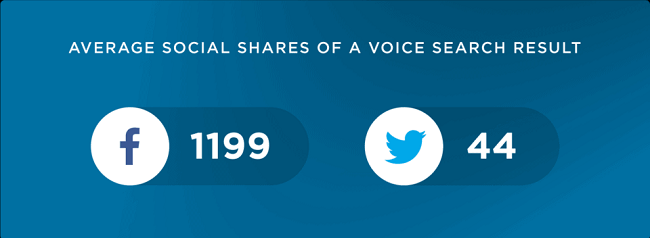
34. Pages that rank for voice searches have around 1200 Facebook shares on average…
…and 44 Tweets. This suggests that social engagement may also be a big ranking factor for voice search. SEOs should take note of this: if you want to rank for voice search, it may help to have a solid social strategy in place and promote your blog posts on social media.
Source: Backlinko
35. The average voice search result has a DR of 76.8
DR stands for domain rating (Ahrefs). It’s a measurement of the perceived authority of a website on a 100-point scale. Authority has always been an important ranking factor, but it seems to be particularly important for voice search as high-authority domains dominate the results.
The reason domain authority is so important is probably due to the fact that there’s a consumer expectation that voice search results should be accurate. In an effort to make sure it’s only giving accurate responses to voice search queries, Google may be carefully selecting responses from only the most trustworthy domains.

Source: Backlinko
36. Pages that rank for voice searches have an average word count of 2,312
Google Assistant also seems to prefer to source voice search answers from long-form content. The upshot: if you want to stand the best chance of ranking for voice search queries, publish long-form content.

Source: Backlinko
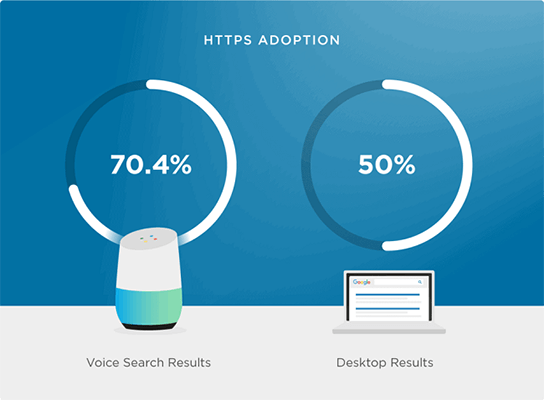
37. Over 70% of websites that rank on Google’s voice search results are HTTPS secured
This stat suggests that HTTPS encryption may be another important ranking factor. If your website doesn’t have an SSL certificate, you may struggle to rank for voice search.
Source: Backlinko
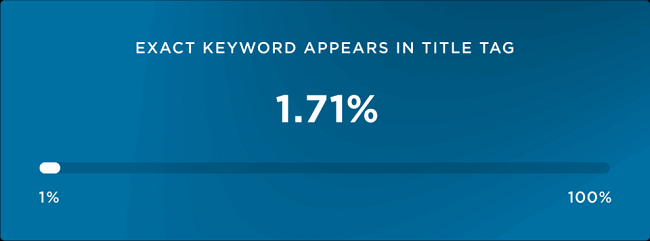
38. Only 1.71% of voice search results come from pages with an exact-match title tag
Keywords only appear in the title tag of a tiny fraction of voice search results pages, so don’t bother creating individual pages optimized around individual keywords. Instead, it’s better to write one pillar piece of content that answers multiple questions on the same page.
Source: Backlinko
Note: This means that you will need to research additional keywords for each of your blog posts. If you need help, check out our comparison of the best keyword research software tools.
39. 58% of voice search users search for local business queries
Local businesses, take note. Over half of people who use voice search do so to search for local business queries. That might mean asking for directions to a local business, or checking opening hours.
Source: SEMrush
40. The average result for local-intent voice search queries is 23 words long
This is the average length of answers to voice search queries across all digital assistants. The upshot: if you’re trying to rank for voice search queries, keep your answers to common search queries short and sweet.
Source: SEMrush
41. Google Assistant sources local-intent search query answers based on Google Business…
…and Local Pack SERP features. In contrast, Siri looks at Yelp reviews and Apple Maps to source answers for local-intent search queries. Having a 4.5/5 Yelp rating and a large number of Yelp reviews helps you to rank on Siri.
Source: SEMrush
Voice search challenges
Voice search has come a long way in the last decade or so, but many consumers still have reservations. Here are a few statistics that highlight the challenges facing the voice search industry.
42. 41% of people fear their digital assistants are actively listening to or recording them
This might sound superstitious, but it’s a very real fear for almost half of all users. 52% also fear their information is not secure with voice assistants.
Source: Microsoft & Bing
43. 41% of smart speaker users are concerned about privacy
People expect privacy in the comfort of their own homes. However, 41% of smart speaker users have reported concerns around trust and privacy. Many of them are concerned that their devices are passively listening in on them. These kinds of fears are a huge barrier preventing the wider adoption of smart speakers.
44. 64% of survey respondents said they’d accidentally accessed a voice assistant in the last month
Of these, almost half said they accidentally did it by pressing the wrong button. We’ve all been there.
Source: Statista2
Voice search statistics sources
- Adobe Consumer Voice Survey (URL no longer available)
- Backlinko
- eMarketer
- Google Mobile Voice Survey
- PWC
- Think with Google1
- Think with Google2
Final thoughts
That concludes our roundup of the latest voice search statistics. We hope you found them interesting and that they helped to inform your SEO strategy for the year ahead.
If you need more help improving your search engine rankings, check out our articles on the best rank tracking software and outreach tools.
And if you’re interested in checking out more statistics, be sure to have a read of our posts on SEO statistics, social media statistics, blogging statistics, and content marketing statistics.
